
Bilateral Teleoperation & Interface Research for Humanoid Robots
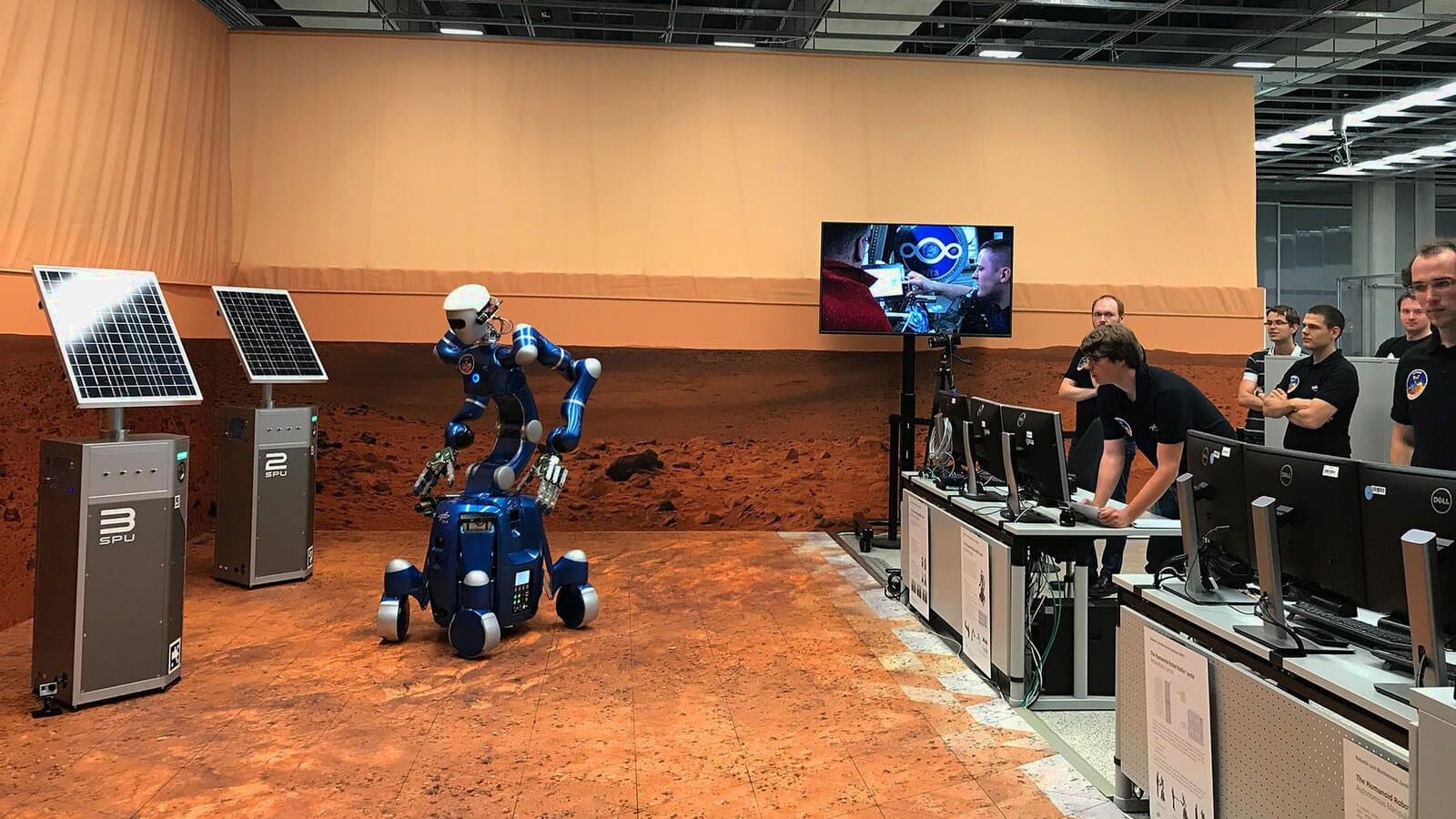
At a national aerospace research institute, we worked on bilateral teleoperation and visuo-haptic interface design for a high-DOF humanoid robot. The research focused on enabling intuitive human-robot interaction under real-world constraints, including latency, limited bandwidth, and complex manipulation tasks. This work contributed to the foundations of space telerobotics research, where astronauts aboard the International Space Station commanded the robot on the ground via high-level interfaces, and it later fed into experiments enabling supervised autonomy for ISS-to-ground robotic operation.
Scope of Work
- Development of bilateral teleoperation control frameworks
- Design of visuo-haptic command and feedback interfaces
- Adaptation of control schemes across robot architectures
- Implementation of real-time haptic feedback loops
- Experimental validation on high-DOF humanoid systems
Key Features Delivered
- Interface enabling transition from teleoperation to supervised autonomy
- Robust human-robot interaction under high-latency conditions
- Task-oriented interaction design reducing operator workload
- Modular architecture supporting reuse in space telerobotics systems
- Foundation for later ISS-based supervised-autonomy experiments
Outcome
The interaction paradigms developed here bridge low-level teleoperation and high-level supervised autonomy, letting an operator command a complex humanoid system under the latency and bandwidth limits of a real orbit-to-ground link. That research fed directly into the ISS supervised-autonomy experiments it was built to support.