
Development of the Legged Robot Forrest
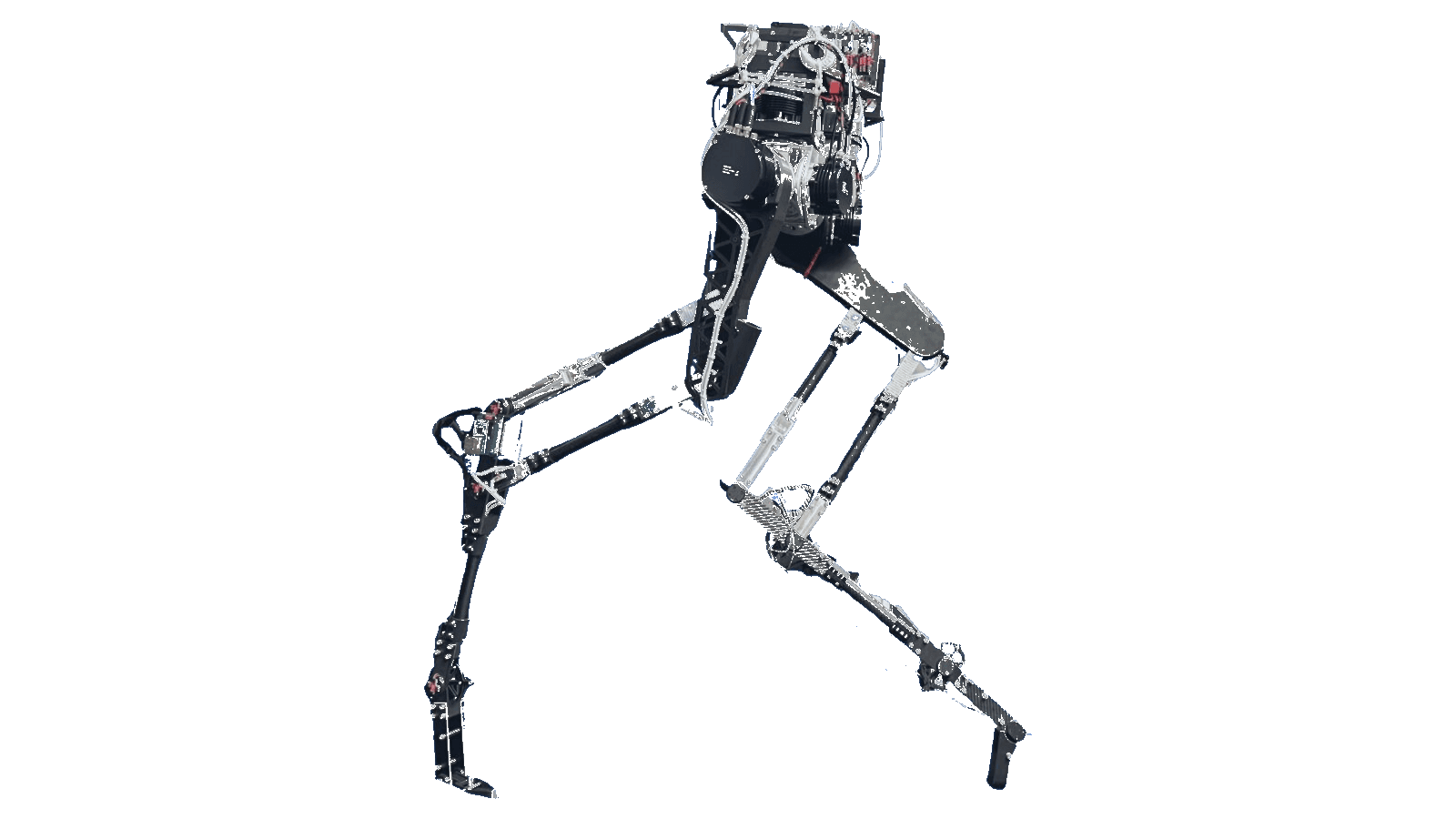
We are leading development of Forrest, an energy-efficient legged robot platform built around mechanically intelligent locomotion. The system combines a tendon-network leg architecture inspired by multi-joint coupling with a learning-based control stack trained in NVIDIA Isaac simulation. The goal is to exploit morphology, elastic energy storage, and reduced actuation complexity to achieve stable, efficient walking with a controller that transfers reliably from simulation to hardware.
Scope of Work
- Mechanical design of an energy-efficient tendon-coupled leg architecture
- Integration of actuation, electronics, sensing, and onboard computation
- Physics-based simulation workflow for legged locomotion development
- Reinforcement learning pipeline for gait generation and policy optimisation
- Sim-to-real transfer and validation on the physical robot platform
Key Features Delivered
- Tendon-network mechanism enabling passive load sharing across joints
- Elastic energy recovery reducing idle and stance-phase losses
- Reduced motor count through morphology-driven mechanical coordination
- GPU-accelerated RL training in Isaac-based simulation environments
- Locomotion policies shaped for robustness, efficiency, and hardware transfer
Outcome
Forrest treats leg mechanics and gait control as a single design problem rather than two separate hand-offs between disciplines: a tendon-coupled leg architecture cuts motor count and recovers elastic energy, while a reinforcement-learning policy trained in Isaac simulation is built to transfer directly onto that hardware. The result is a research platform for efficient, scalable legged locomotion with a defined path from concept to deployable hardware.