
Vineyard robots need a map first. We built one from open aerial data.
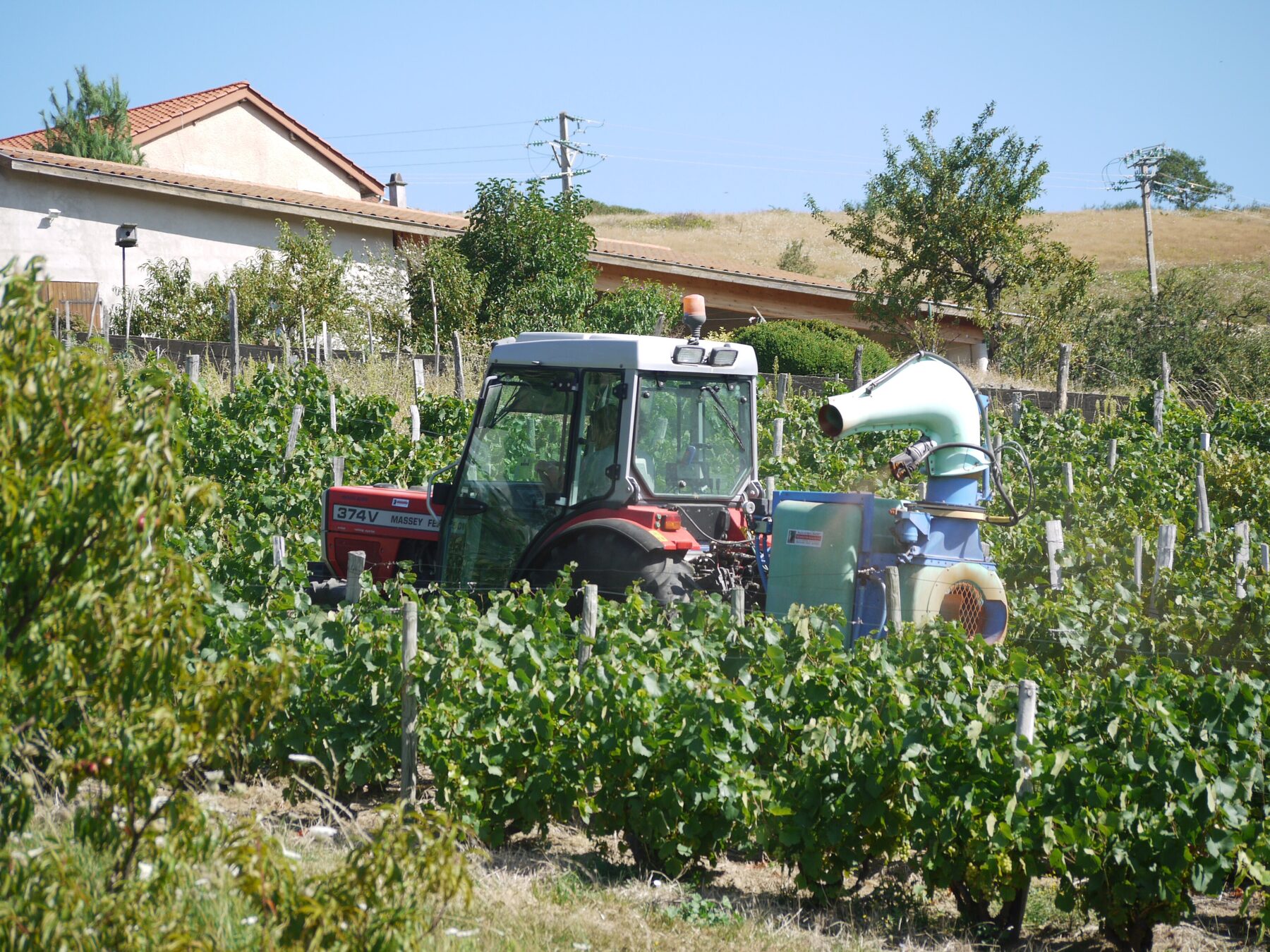
Pest control in a flat, fully mechanised German vineyard costs about €338 per hectare and year in labour and machine time. On a steep slope worked by hand, the same job costs €3,399. Those numbers come from a study of 2,321 working-time records on 28 vineyards at five German estates (Strub and Loose, OENO One, 2021), and spraying turns out to be the single biggest line in the gap between flat and steep.
That gap is why vineyards keep attracting robot builders. It is also why so many of them have struggled. And it points at a problem that gets far less attention than motors and batteries: before a robot can spray or harvest anything, it has to know where the rows are.
We built that part for a client. This post covers why vineyards are a serious robotics case, why they are hard, where the industry stands, and how our vineyard mapper works, including where it does not.
Why vineyards are a real business case
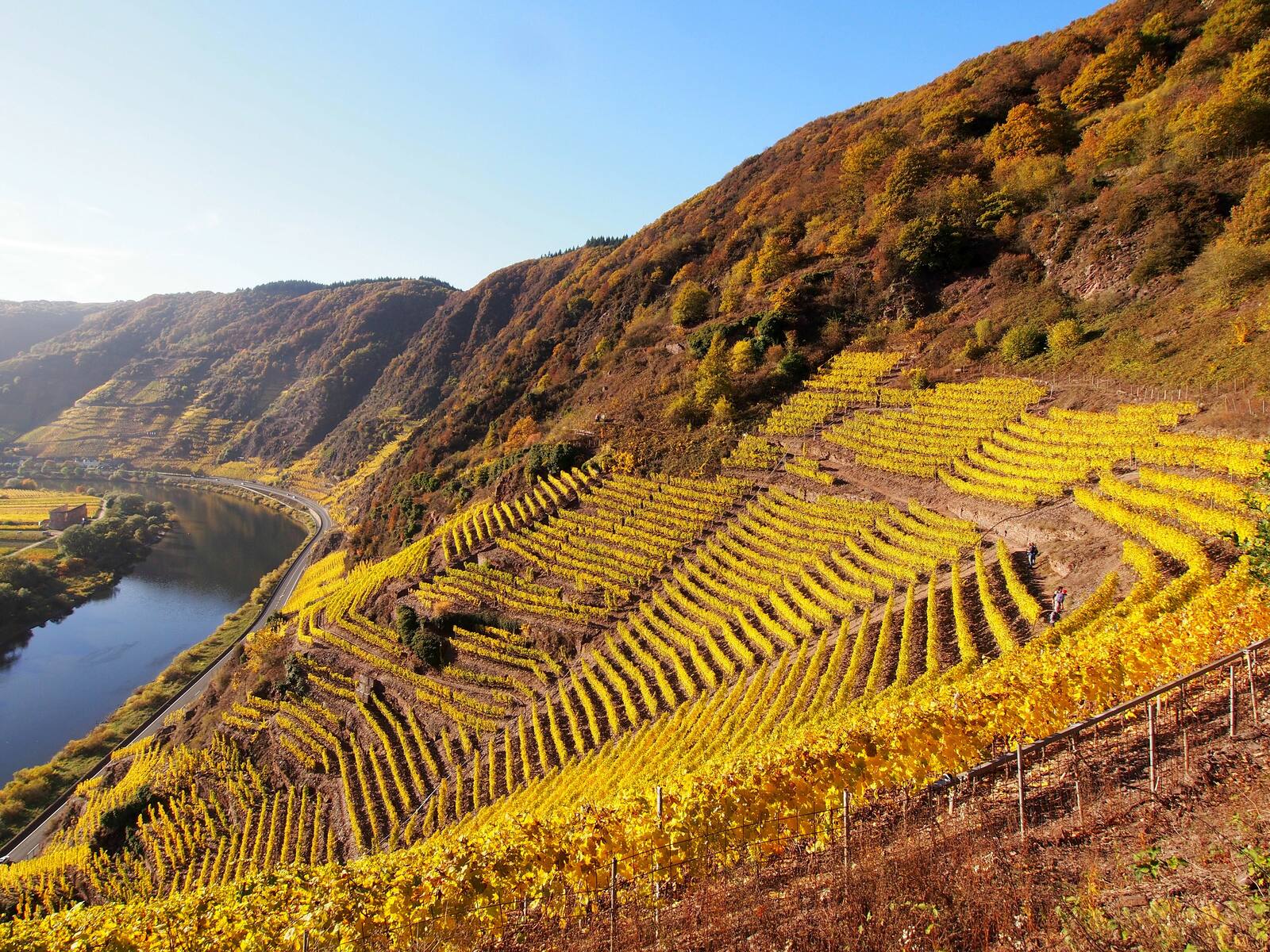
In the same study, total labour and machine cost per hectare was €4,720 on flat land, €9,822 on rope-assisted steep slopes and €12,320 on manual steep slopes. That is 2.6 times the flat figure. It excludes about €1,000 per hectare of materials, and it reflects 2017 to 2019 wages, which have risen since.
Working time tells the same story. The German Wine Institute puts flat, well-mechanised land at 200 to 250 hours per hectare and year, and steep slopes at 800 to 1,600. About 14,000 hectares of German vineyard, 14 % of the total, are steep slopes, around 3,500 of them on the Mosel.
Three pressures push in the same direction:
- Repetition. Pest control happens 7 to 14 times per year in German trellised vineyards, so every saved pass counts several times over.
- Labour. In 2023, 31,700 of the 67,700 people working on German vineyard farms were seasonal workers, 47 % of heads (Destatis). The statutory minimum wage rises from €13.90 to €14.60 an hour at the start of 2027.
- Rules. Spraying from the air, drones included, is banned in principle in the EU, with exceptions for steep-slope viticulture that need a state permit. The binding EU pesticide-reduction regulation was withdrawn in February 2024, but the Commission still reports a 56 % drop in its use-and-risk indicator from 2018 to 2024 against the 2015 to 2017 baseline. Precision application is the direction of travel. Reported savings from map-based variable-rate spraying include 44 % less copper in one study.
And from 20 January 2027 the new EU Machinery Regulation explicitly addresses autonomous mobile machinery. We wrote about what that means for anyone adapting robots in October.
Why it is hard
Vineyards combine nearly every difficulty in field robotics.
Slope. Standard tractors stop being usable at around 40 % gradient. Above that, crawlers work on winch ropes, passing each row twice, or people do it by hand. After rain, steep sites can be impossible to enter at all.
Narrow rows. German rows are typically about 2 m apart with vines every 1.2 m. That is why vineyard robots are either straddle machines or slim platforms such as the sub 1 m wide WETA built in the EU project SCORPION.
Satellites under the canopy. Researchers at FBK in Trento note that in Guyot and pergola vineyards, dense foliage forms archways that degrade GNSS signals. Their test canopy, about 3 m high, significantly obstructed the satellite view. RTK-GNSS is the standard in open sky and unreliable exactly where the robot works.
Time windows. One Quincy winegrower told Le Figaro that climate change and the withdrawal of plant-protection products mean shorter intervention windows: in spring, every vine needs treating at once.
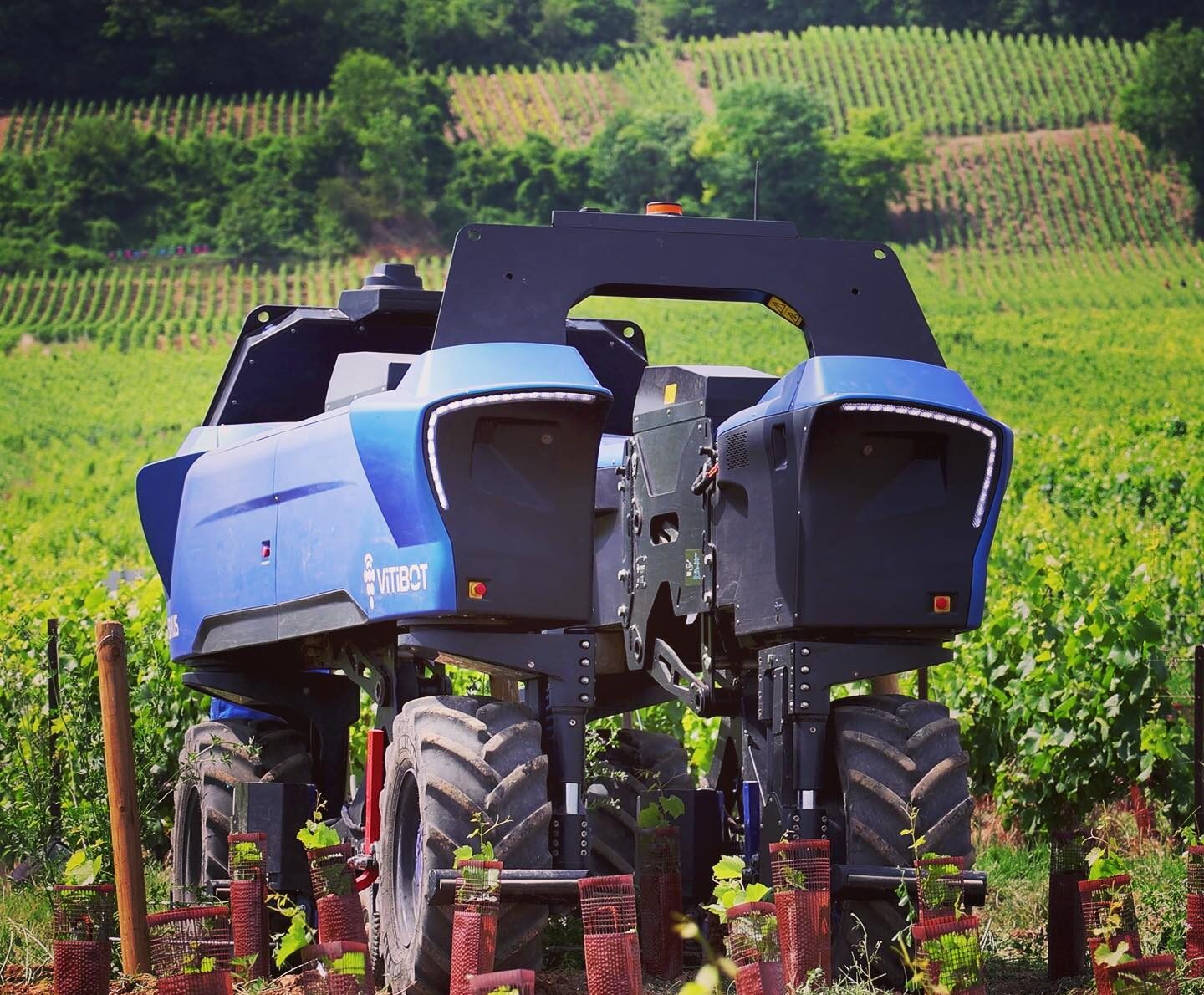
Setup per parcel. Le Figaro reports that each parcel has to be mapped before a VitiBot can work, and the robot travels by trailer because it may not drive on public roads. That is time before the first row is treated.
Economics. A VitiBot Bakus costs about €200,000, roughly the price of a good conventional straddle tractor, and is still supervised by an operator nearby. Around 200 are in operation. The market has not been kind to others: Naio Technologies, maker of the Ted vineyard robot, went into receivership in June 2025 and was taken over that November with 21 of 53 staff retained. The arable-focused Robotti maker Agrointelli went bankrupt in February 2026. Monarch Tractor, which pitched itself at California's wine industry, sold its technology to Caterpillar in April 2026.
Where it stands
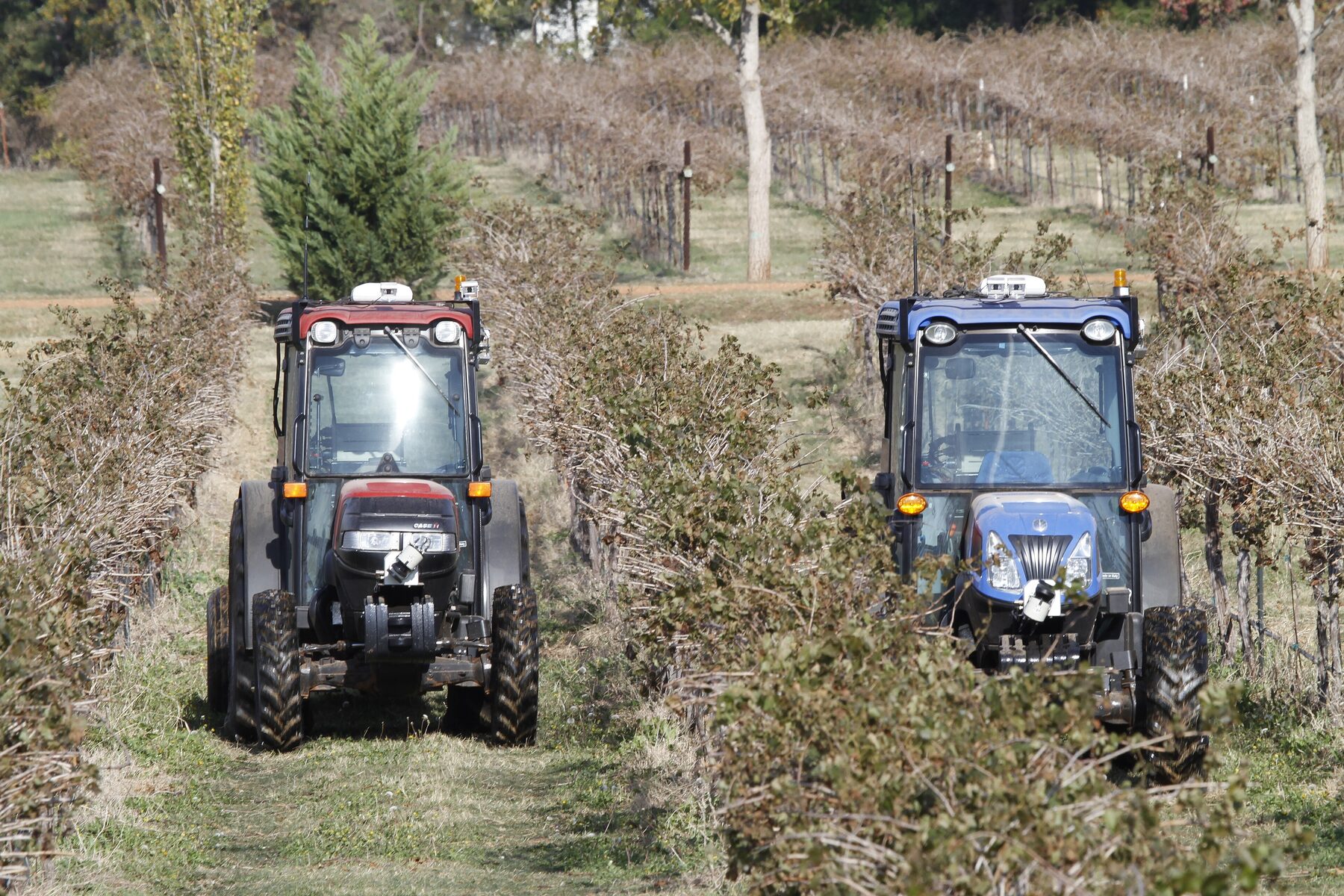
Commercial: straddle robots for soil work and spraying, crate-carrying platforms such as Burro (which reports more than 800 robots, a company figure), and autonomy kits for existing tractors. Autonomy in vineyards is not new either: ASIrobots showed two driverless tractors spraying together in a Texas vineyard back in 2012.
Research and funded projects: SCORPION's WETA robot combines RTK-GNSS where a network exists with LiDAR, cameras and inertial sensing, falls back on natural landscape features when it detects GNSS anomalies, and sprays according to geo-referenced prescription maps. In 2025, FBK planned an inspection route from a 10 cm orthophoto, finding rows from NDVI peaks and turning them into waypoints. A real mission ran autonomously on four lanes of about 100 m. Their failure case is instructive: a steep vineyard under low sun, where rows were confused with inter-rows.
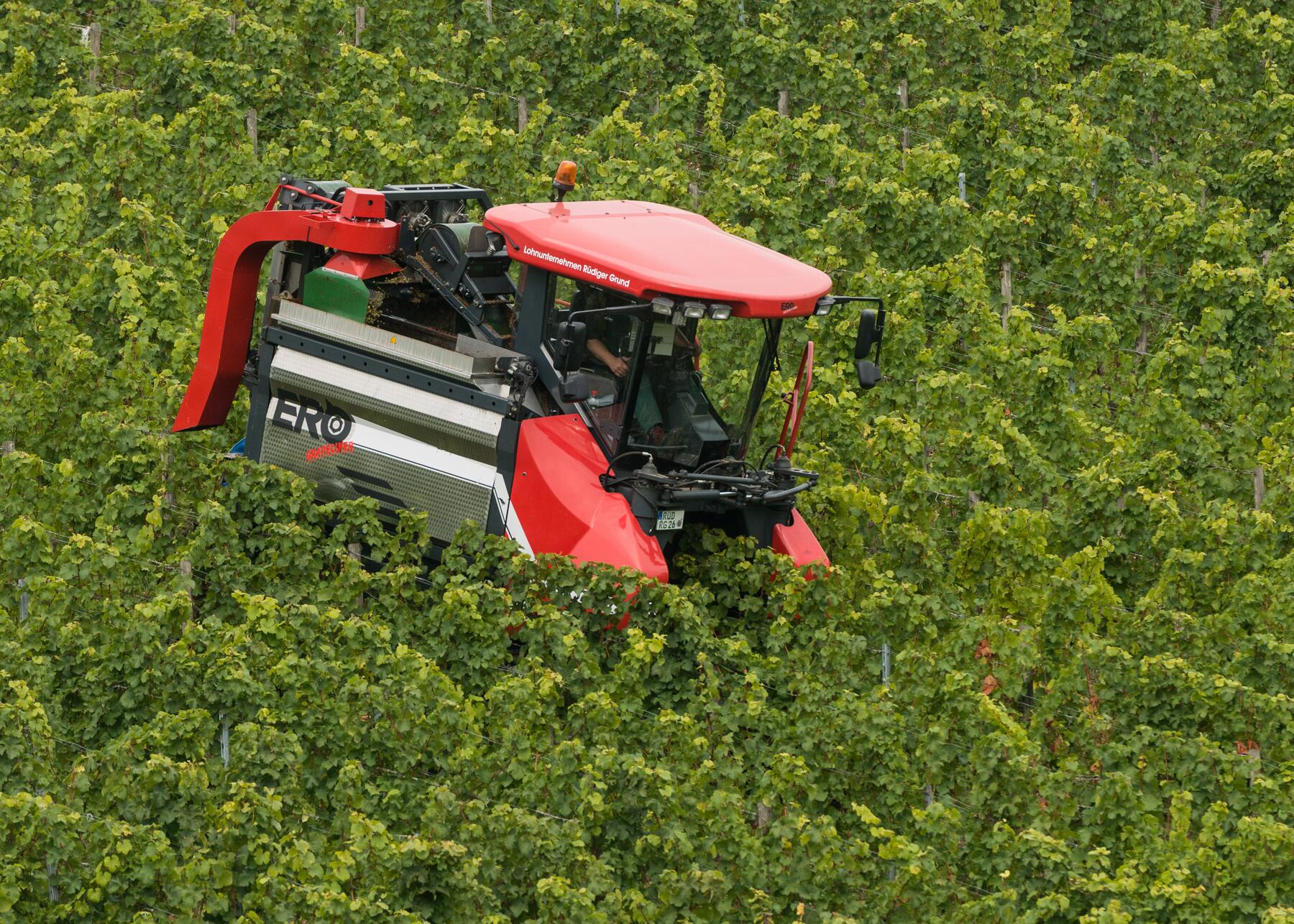
Harvesting deserves an honest paragraph. Mechanical harvesters are standard on flat, wide-row, trellised sites. A German contractor reports about 100 minutes per hectare against roughly 8 hours by hand, with machines costing €300,000 to €350,000 and breaking even at around 60 to 100 hectares a year. Selective autonomous picking, though, is still prototype and research territory. A February 2025 trade review put it plainly: grape-picking machines, as opposed to vine-shaking machines, are few and far between, and complete automation is still several years away.
The pattern across all of it: every robot, commercial or research, needs a description of the vineyard before it works. Rows, spacing, entry points, turning space, slope. Today that usually means a person walks or drives the parcel first.
The vineyard mapper
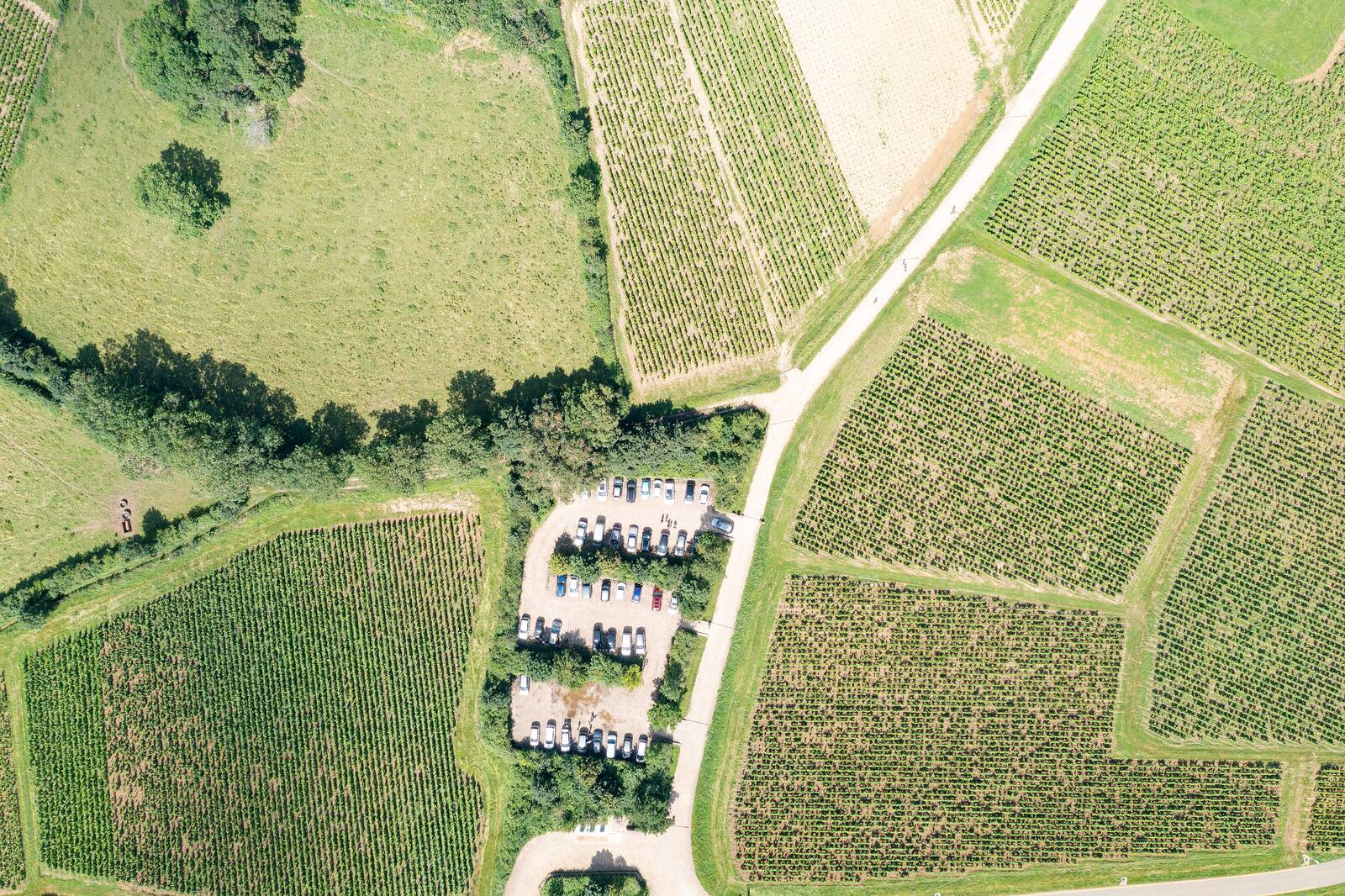
A client of ours runs robots for spraying and harvesting in real vineyards. We built the computer vision and navigation logic that tells those robots where to go, starting from data that already exists. The vineyard mapper takes the open data of Rheinland-Pfalz: a 0.2 m RGB and near-infrared orthophoto plus 1 m terrain and surface models. The user draws a fence around a vineyard, and only that area is mapped.
Why periodicity instead of a trained model
Vine rows are close to a periodic signal: canopy, then inter-row, repeated every 2 m or so. We exploit that directly. A local FFT of the NIR band finds the dominant row direction and spacing. A fold refinement and quadrature demodulation then follow the row phase along its length, so curved rows are traced properly, and missing vines show up as gaps where the signal drops.
The reasons we skipped a neural network are practical. There is no labelled training data, no per-region retraining and no model that quietly fails on the next flight's lighting. The method is deterministic and inspectable, and runs on a laptop. To be clear, Fourier analysis for vineyard detection in aerial images goes back to the mid 2000s, and NDVI-peak row finding is what FBK used in 2025. The work here was in making it follow curves, and in everything that happens after the rows are found.
What it produces
From the rows, the pipeline builds a full working description of the block:
- numbered rows, with the vine signal along each one
- farm tracks, and a route graph from the road to row 1
- headland depth and slope per row
- canopy gaps of 2.5 m or more, flagged
- a skip-row coverage mission, with U-turns where the headlands allow and omega turns where they do not
The outputs are GeoJSON, a Nav2 route graph and mission YAML with GNSS waypoints every 1 m, so a ROS 2 robot can consume them directly. We also built the interface to draw the fence and inspect the result, and the showcase film. The film is a render of the planned mission on the real mapped data, not footage of a robot in the field.
Results
On a test area of 0.49 km² with 23 blocks and 1,340 rows, the whole run takes about 35 seconds on a laptop CPU after the download. 95 % of the detected rows lie on an NDVI ridge. That checks the rows against the imagery, not against surveyed vines. On one 81-row block, the mapper reports an 8 % mean slope, 50 flagged gaps, 79 of 81 turns fitting the headlands, and a 9.1 km mission.
Honest limits
- Position. Absolute accuracy is limited by the orthophoto, around 0.3 to 0.5 m against RTK. The map is a global prior, and the robot still follows the row with its own sensors.
- Flight date. In spring flights, posts and bare soil dominate, and the gap detector does not work.
- Row pattern. Pergolas, terraces and single-stake Mosel vineyards without a clean row pattern are not detected.
- What a gap means. It is a stretch where the row signal drops. From above, a missing vine and weak growth look the same.
What this means
For vineyard operators, a map built from open data means the first plan for a parcel exists before anyone drives there, and with many parcels that adds up. For robot makers, it removes the per-parcel survey step from the first deployment and hands over a route graph in the format their stack already uses. It does not replace onboard perception. The two layers complement each other: the map says what, where and in which order, and the robot's sensors close the last half metre and handle everything that has changed since the flight.
Nothing here is finished. Open orthophotos exist only in some regions, and terraces and pergolas need other methods. But the building blocks (remote-sensing data handling, computer vision, geometry, mission planning, ROS 2 interfaces) are the same ones we use across our robotics work, and they fit together well.
If you run vineyards, or build robots for them, and want to see what this would give you on your own parcels, get in touch. We are happy to talk through it.
Sources: Strub and Loose, OENO One 55(1), 2021; German Wine Institute on steep-slope vineyards; Destatis, labour in viticulture; BVL on drone spraying in steep-slope viticulture; European Commission, pesticide reduction progress; Le Figaro Vin, March 2026; Vitisphere on Naio; Future Farming on Robotti; FBK, ISPRS Archives 2025; CORDIS on SCORPION.